The Vital Role of Market Segmentation in the Tourism Industry

- Market segmentation groups customers by similar needs and preferences.
- OTAs can offer personalized services by targeting specific traveler types.
- Effective segmentation benefits end users by providing consumer-centric products and services.
- Some benefits for OTAs include: target the right consumers and offer personalized travel products.
Would you prefer to listen rather than read?
The tourism industry is an ever-growing and competitive landscape, presenting both challenges and opportunities for businesses operating within it. This is where segmentation in tourism comes in handy.
In this blog post, we will discuss what market segmentation is, the importance of market segmentation in the tourism industry, and how online travel agencies can benefit from it.
What is Market Segmentation in the Tourism Industry?
Market segmentation in the tourism industry is the process of grouping a large market into subgroups of customers with similar needs and preferences.
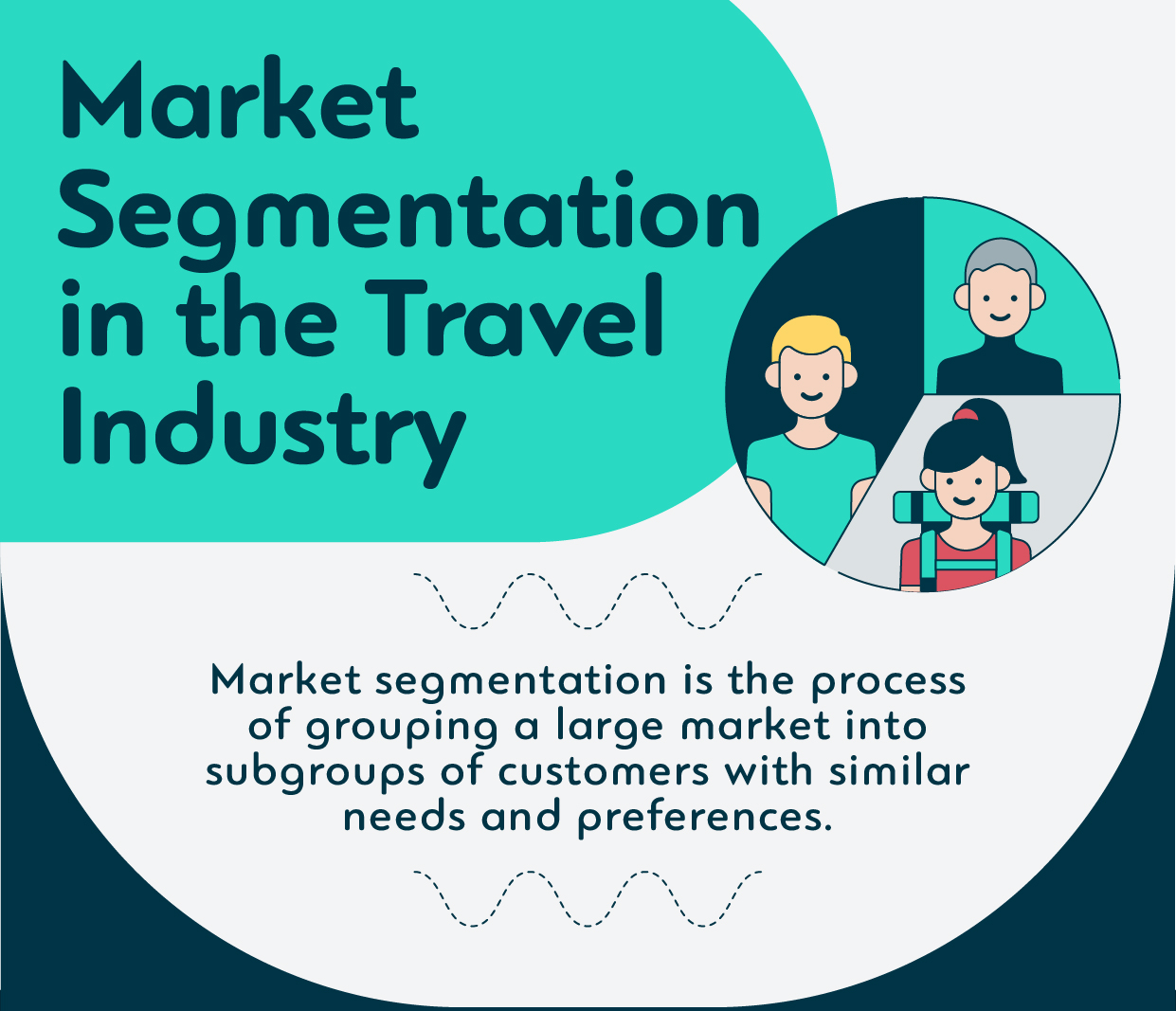
Definition: Dividing a market who have different needs into groups that have similar needs.
The main goal of segmentation is to classify consumers based on shared interests. This results in content that gets seen, messaging that gets heard, and products and services that get sold.
The Role of Market Segmentation for Online Travel Agencies (OTAs)
Segmentation allows online travel agencies to cater to different types of travelers with unique and diverse interests, lifestyles, preferences, aspirations, expectations, and habits.
The challenge OTAs and those within the tourism sector face is that they are all selling the exact same product. For example, if a traveler wants to say at the Four Seasons Resort in Dubai, they can book directly or via Booking.com, Hotels.com, and Expedia.
Companies that cannot differentiate themselves in the market become interchangeable with similar ones. Consequently, customers base their purchasing decisions solely on the cost of the product or service, leading to decreased profit margins.
When you segment-specific markets, you stop competing over price and start competing over value.
The Benefits of Effective Market Segmentation
There are several benefits of effective market segmentation for both the end user and online travel agencies.
The Benefits of Effective Market Segmentation for End Users
- Products and services are consumer-centric
- Segments feel seen and heard
- Consumer needs exceed expectations
- Improve travel experience
The Benefits of Effective Market Segmentation for OTAs
- Targeting the right consumers
- Offer personalized travel products and services
- Identify new and unmet needs
- Identify unexplored segments
- Differentiate from the competition
Why is Market Segmentation Important in Tourism?
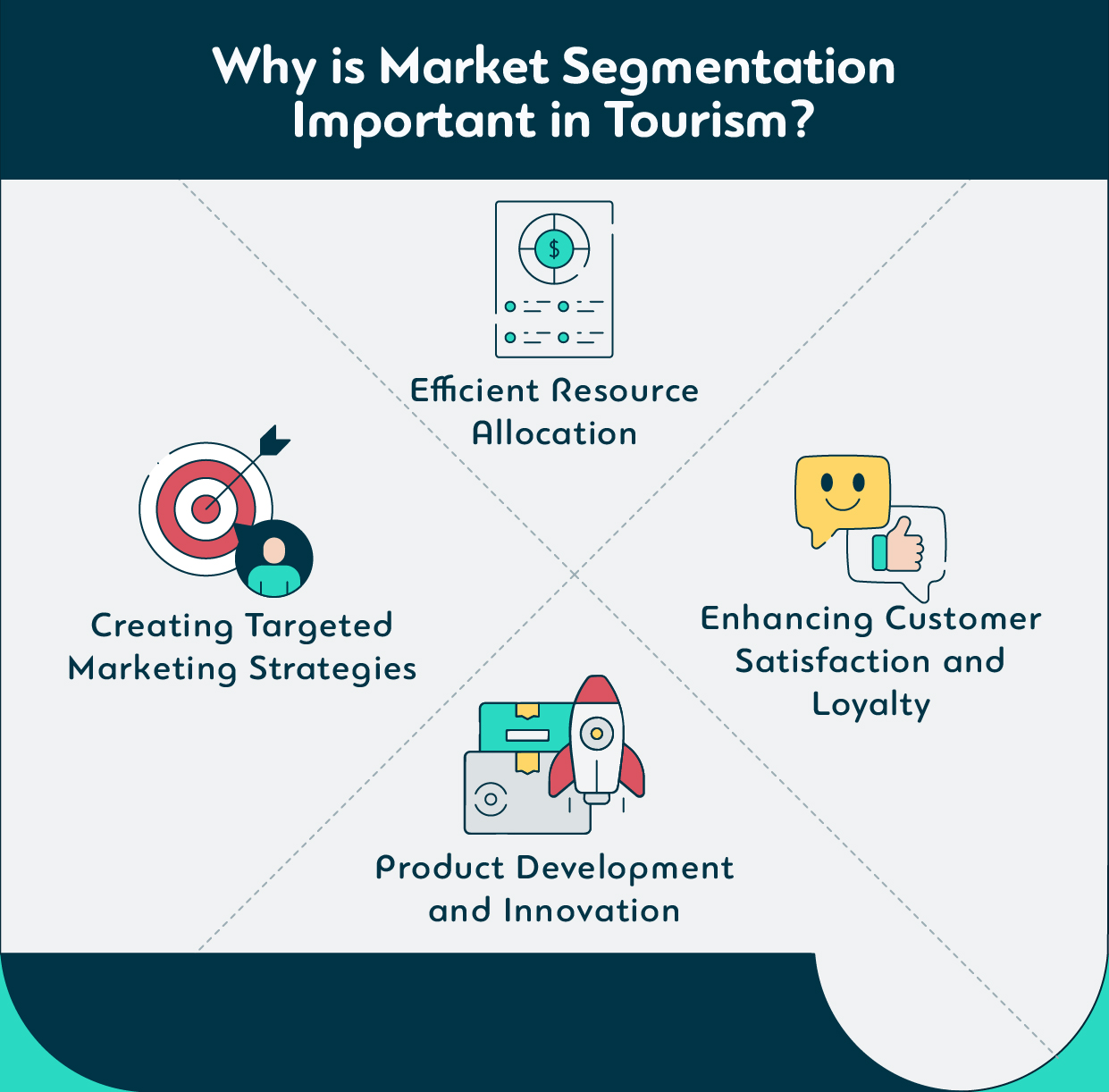
1. Creating Targeted Marketing Strategies
Market segmentation enables OTAs to develop more effective marketing strategies that attract and retain customers. This is because segmentation allows them to target different customer clusters with tailored offers and messages that burn through the noise as opposed to cookie-cutter campaigns.
Backpackers and business travelers have different interests, just as families and couples on holiday have different interests. Once you have identified your segment, you can target them based on what interest them.
One simple strategy when it comes to email marketing is to segment your email list based on buyer personas. This way, you can customize your messaging to address their specific interests and needs instead of sending the same email to everyone.
2. Efficient Resource Allocation
The more effective marketing strategies become, the more efficient businesses become at allocating their resources. This is because they stop wasting resources on irrelevant products and services that do not appeal to their customer base because they know exactly who their customers are, what they want, and how to target them.
A brand that knows who their customer is can create products and services that their customers want and tailor their messaging to attract the people most likely to purchase them.
This means businesses can allocate their resources more efficiently by focusing on what their customers actually want and need instead of what they ‘think’ they want and need.
3. Product Development and Innovation
Market segmentation helps businesses identify their customer’s needs and preferences, enabling them to develop and alter their products and services to meet their expectations. OTAs can create segment-specific offers and packages based on these insights.
Once you have chosen your specific segment or segments, it’s important to tailor your product to the unique characteristics of that segment. For example, offering a breakfast package for family travelers or a couple’s package for honeymooners.
Unique pricing options or personalized value add-ons can be developed for each segment. Price discrimination is a selling strategy OTAs can use to charge different rates to different customers for the same product or service.
For example, for hotel rooms, an OTA can:
- Sell at a higher rate based on what customers are willing to pay
- Sell at a lower rate based on what customers are willing to pay
The luxury travel segment has a higher tolerance for spending more money on their travel experiences and services. While the family travel segment is more likely to focus on finding the best deals or trying to get the most out of their money.
This can be key in identifying what price will make them jump at the opportunity and what price will make them run for the hills.
4. Enhancing Customer Satisfaction and Loyalty
The main goal of segmentation is to better serve the customer. As a result, businesses are better equipt to meet customer needs and expectations. Consequently, leading to an increase in customer satisfaction and loyalty.
By creating target marketing campaigns that resonate with prospects and customers, allocating resources efficiently, and developing products and services that meet the needs of each segment, businesses can deliver a higher level of customer satisfaction that results in repeat business and positive word-of-mouth.
For example, when you link the expectations and needs of your customers to the tour packages you create and sell, you’re customers are more likely to experience greater satisfaction.
To evaluate the potential of a segment, you can review 5C’s:
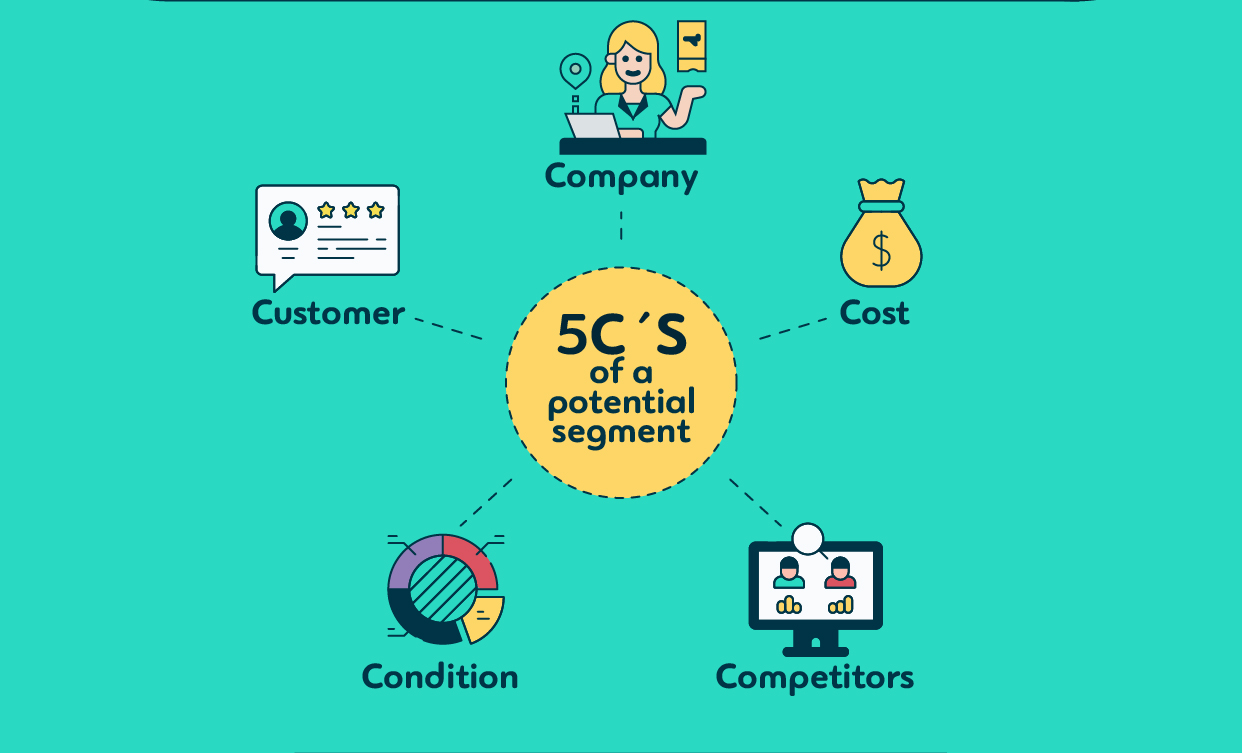
It’s important to identify whether the segment you would like to choose is a viable option. As while some segments may seem like a fit, they might not provide the type of scalability you desire for your business, or they might be too costly to acquire. Let’s take a look at several factors to take into account.
- Customer: Is the chosen segment ‘attractive’ in terms of profitability? (aka how much are they willing to pay)
- Condition: How big is the market size and growth rate? (market potential)
- Cost: How much does it cost to reach the chosen segment? (customer acquisition cost)
- Company: Is this segment compatible with the company’s objectives, capabilities, and resources? (company/segment fit)
- Competitors: Who are the main competitors? (Global OTA market share)
Now that we understand why market segmentation is so important, let’s take a look at the main segments of market segmentation.
What are the 4 Segments of the Tourism Industry?
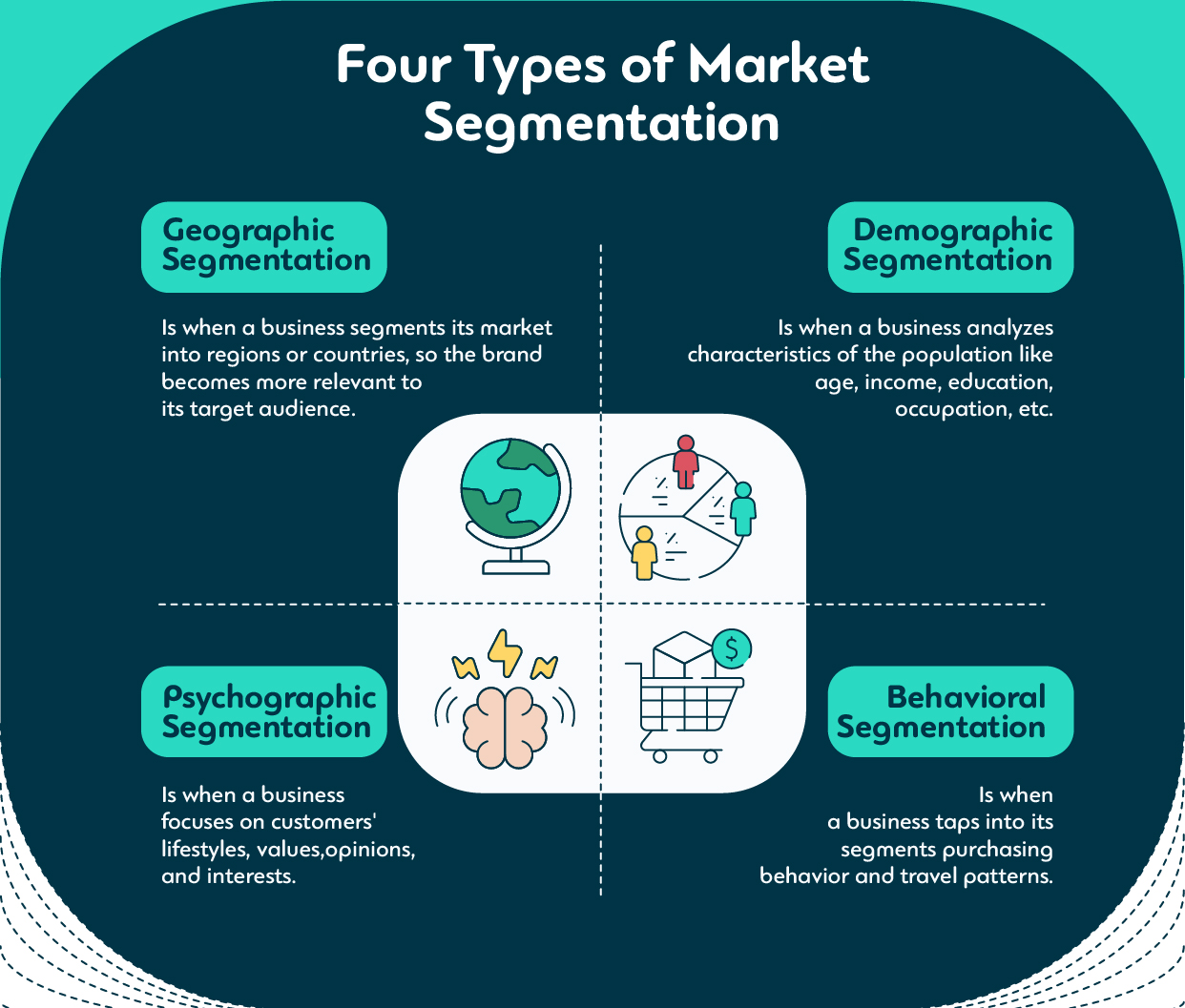
The tourism industry has four main segments, which involve identifying and targeting specific customers and categorizing them according to their geographic, demographic, psychographic, and behavioral characteristics.
1. Geographic Segmentation
Geographic segmentation is when a business segments its market into regions or countries. This can help them understand where their target audience comes from so they can tailor their marketing campaigns and messages accordingly.
Segmentation by geographic location makes a brand more relevant to its target audience, and its resources get allocated more efficiently.
For example, according to Google Travel Insights, France has The United Kingdom, The United States, and Italy as their top 3 sources of inbound demand. OTAs and local businesses in France can use this knowledge to help them better understand the people visiting their destination and buying their products and services.
2. Demographic Segmentation
Demographic segmentation is when a business analyzes the characteristics of the population. For example, age, income, education, occupation, and several other factors.
These factors can help you fine-tune your marketing strategies to relate to that chosen segment. Just like consumer behavior changes, it does the same as we age. Similarly, those with similar income levels will also seek out similar travel experiences.
For example, those traveling as young adults will expect a different experience than seniors. One group is more likely to want to say at a hostel and backpack, while the other group would prefer to have their own room with a little bit more luxury.
This type of data can be used to determine the market size and potential of the demographic segment chosen. One key demographic that travel companies should focus on targeting is Gen Z. This generation consists of late teenagers to early adults who are known to be the largest and most ethically diverse generation in the U.S. and have grown up online.
3. Psychographic Segmentation
Psychographic segmentation is when a business focuses on customers’ lifestyles, values, opinions, and interests. This helps companies to identify different customer personalities and create more targeted marketing messages that resonate.
Psychographic segmentation allows brands to tap into the emotional triggers and pain points that make people buy. This type of data can be invaluable in understanding the customer journey your segmented audiences takes from beginning to end.
This data informs how a company decides to market itself and communicate with its audience. For example, if an OTA wants to market to Gen Z, it will differ from how they market to millennials or boomers.
4. Behavioral Segmentation
Behavioural Segmentation is when a business taps into its segments purchasing behavior and travel patterns. Brands can group behavior based on seasonality, frequency of purchases or trips, and the amount spent on travel-related products and services.
For example, many European countries can expect increased demand for travel to the region in the summer months. OTAs can use this knowledge to forecast demand surges, manage inventory supply and price their products accordingly.
Additionally, this can guide the types of promotional activities marketed. For example, in the summer months, travel agencies can create summer travel deals for their target audience to take advantage of.
The four segments are often used in tandem when planning out marketing campaigns. For example, an OTA creating an Ads campaign will likely target a specific segment that lives in a particular area with unique interests, values, and behaviors.
The data they collect above can help them target those more likely to buy instead of a broader audience that may not be interested in their offer. This allows the OTA to save money, reach more people with the right message, and increase their ROI.
How to Use Travel Segments in Your Marketing Strategy
“People want hyper-personalized experiences to feel they are traveling with intention,” says psychologist Lee Chambers. Regardless of industry, 90% of leading marketers say personalization boosts profitability, while 76% of consumers say personalization makes them more likely to buy.
Obviously, tailoring products and experiences to travelers’ needs, wants, interests, and tastes is key to their hearts. But not so fast. First, you need to incorporate that into your marketing strategy. Failing to do so correctly will stop you from reaching the right people at the right time.
How do you identify and define different travel segments? And how do you use them in your marketing strategy to improve your likelihood of success? This section will help you answer all your questions. We will also provide practical tips and examples taken from successful businesses.
The Importance of Travel Market Segmentation for Targeted Marketing Campaigns
As we said before, market segmentation can help travel businesses understand their customers, delight them with personalized experiences, and, with that, improve their bottom line. All that sounds great on paper, but how do travel brands implement this market segmentation insight?
Although marketing is a continual process, it must be divided into measurable milestones. That’s why we have campaigns. A marketing campaign is defined by a realistic objective and a target; without a clear understanding of who it is aimed at, everything you do is just a shot in the dark.
Enter market segmentation. Here’s what makes it invaluable in travel marketing:
- Hand-Picking Marketing Channels-Social media provides the best opportunities for targeted marketing, both organic and paid. The trick is you need to know what social media platform to choose. Like travel preferences, social media tastes vary among users.
For example, Facebook is mostly used by men in their thirties, while Instagram’s main audience is younger and gender-neutral. TikTok is the network of choice for young adults. Whether you choose one or all three, segmentation will help you make the best of it.
- Tailoring Personalized Messages-Businesses that cater to a wider and more diverse audience rely on dynamic content to help them address different types of consumers. Dynamic content is web content that adapts to users’ interests, preferences, and behavior.
Dividing your audience by segments allows you to create blog articles, social media posts, and targeted emails for a specific type of traveler. Segmentation will also help you determine the content form and language your audience is most likely to respond to.
- Travel SEO and Keyword Research-92.96% of global traffic comes from Google Search, Google Images, and Google Maps. The best way to leverage this as a tourism business is with local SEO, which takes advantage of destination-specific queries and keywords.
Besides informing your content strategy, segmentation also helps you understand variations in keyword usage, optimize Google My Business listings for different users, and personalize landing pages based on visitors’ locations or the destinations they wish to visit.
How to Identify and Define Different Travel Segments
Surely, you think about your customers a lot: where they like to travel, when they like to travel, and what they like to do when they get there. But answering these questions is not always easy. People are easily influenced by the internet and can surprise you with an unexpected travel choice.
That is why audience segmentation must be data-based. The usual practice is to categorize customers based on demographic, psychographic, geographic, and behavioral data. A combination of these groups of characteristics can give you a holistic view of a typical segment representative.
Based on this data, travel businesses usually differentiate five market segments:
Solo Travelers
People who prefer to travel alone are independent and confident. Businesses often make the mistake of presuming that solo travelers are spontaneous and adventurous, but that isn’t always the case. They like their freedom to roam (46%) and don’t want to wait around for others (22%).
For some solo travelers (15%), travel is a way to challenge themselves and gain confidence. They enjoy visiting tourist hotspots as much as they like off-the-beaten-path experiences. While around half of them like meeting other people while traveling, up to 84% travel to enjoy food and drink.
Family Travelers
Family travel hasn’t changed much since the 1980s. This market segment remains largely driven by what children need and want: safety and hygiene, kid-friendly amenities and activities, outdoor recreation and relaxation, and experiences that foster intellectual growth and passion for learning.
Notable changes since COVID-19 include an increase in budget-conscious family travelers, with 59% of this travel segment being concerned about affordability. Despite that, 79% of families want to travel to international destinations, preferably Europe, Canada, Mexico, and the Caribbean.
Adventure Seekers
When it’s time to choose a travel destination, experiences are now the leading factor for 98% of people. Adventure seekers are no longer hikers, campers, and backpackers, at least not exclusively. This segment is being redefined by the rise of the post-pandemic vacationer: the “Explorer.”
Still, the adventure segment is so large (valued at 483.3 billion in 2023 and expected to grow by 15.2% before 2032) that savvy travel businesses divide it by preferred activities. In addition to physical activity, adventure typically involves contact with nature and cultural immersion.
Luxury Travelers
Luxury travelers are perhaps the least understood travel market segment. They are typically perceived as wealthy, gray-haired individuals from the US and Europe who crave exotic experiences and travel around on yachts. However, recent research is revealing a new type of affluent traveler.
By most definitions, these people are willing to spend an average of $500 per night on lodging. 80% are younger than 60 and prioritize “novelty, culture, history, and authentic experiences.” Unless they are ultra-wealthy, they splurge on special occasions but not on every aspect of the trip.
| Travel Market Segment | Channel | Content | Call To Action |
| Solo Travelers | Social media, email marketing, and search engines are the best ways to target solo travelers. Social media allows you to reach various demographics, SEO lets you target travelers based on their location and the destination they want to visit, and email is excellent for marketing personalization. | Solo travelers respond to compelling visuals, inspirational blog posts, and resourceful travel articles. You can catch their attention with imagery of people enjoying their alone time, expert advice for solo travelers, local recommendations, and safety tips. UGC is also valuable because it provides reassurance. | Individuals who like to travel alone want unique experiences but worry about safety. They want flexible options and customized itineraries. |
| Family Travelers | Family travelers also use social media and email, but their travel decisions are mostly based on research conducted on search engines and metasearch platforms because they compare prices and plan their trips extensively. | In addition to visual content highlighting the relaxing ambiance and family-friendly activities, these travelers also want informational content with details on what they can expect once they arrive at the destination and hotel. | Parents who travel with kids want stress-free and affordable travel options above all else. |
| Adventure Seekers | Adventure seekers are often influenced by what they see on social media, so you can target them with influencer marketing campaigns. They also watch TikTok and YouTube to get travel inspiration. | This travel segment is excited about natural wonders and unique experiences. A mix of stunning photography, video marketing, travel tips, and personal stories can spark their passion for travel. | Travelers who seek adventure want to feel excited, challenged, and awe-inspired. They also like participating in sustainable initiatives. |
| Luxury Travelers | Contrary to popular belief, luxury travelers are not unreachable via traditional digital channels. As a matter of fact, the top marketing platforms for this travel segment are Instagram and Facebook. The most effective campaigns involve partnerships with luxury brands. | High-end photography, video stories, and virtual tours that highlight the appeal of exclusive travel destinations and elevated experiences. Luxury travelers are also attracted to well-crafted travel blogs and email newsletters with | Luxury travelers want elite and extraordinary travel options. They prefer handpicked, curated, and exclusive travel experiences. |
Leveraging Micro-Moments in Travel Marketing
Answering where, when, and what doesn’t tell you the whole story about your audience segments. You must also ask: how do they plan their trips in 2024? Consider these statistics:
- 14% of Millennials rely on AI tools like Copilot and Gemini to plan their trips, and 66% plan and book their trips using online platforms and travel apps.
- A significantly larger portion of Gen-Z travelers (42%) plan vacations inspired by the short videos they see on social media – especially TikTok and Instagram.
- 69% of travelers prefer to keep their travel plans flexible, while 55% would rather travel without a plan. The majority of tourists are open to last-minute trips.
- 80% of travelers prefer to plan their vacations entirely online.
Technology is a huge facilitator of on-a-whim travel planning. Convenient research and booking options offered by online travel agencies (OTAs) and AI travel apps allow travelers to indulge their impulses as soon as they sense wanderlust. In marketing, we call this “micro-moments.”
Micro-moments occur when consumers rush to their devices in search of an answer, idea, or solution. There are four types of micro-moments in travel, one for each stage of a traveler’s booking journey: “I want to get away,” “Time to make a plan,” “Let’s book,” and “Can’t wait.”
Learning how to leverage these moments can completely transform your marketing strategy. Define your market segments right, and you will be able to reach the right type of traveler. But if you can successfully predict their micro-moments, you can also catch them at the right time.
Customer journey mapping, Google Trends, and big data analytics can help you with this. Then, you can schedule a targeted ad campaign for a specific time and get your audience’s attention when they are most likely to act. This way, you can significantly boost mobile conversions.
Tips for Integrating Segmentation into Your Travel Marketing Strategy
Using segmentation to tailor targeted marketing campaigns can engage avid travelers, increase their satisfaction, and turn them into customers. Here’s how to make it happen:
Use Email for Segmentation
Market segmentation could be a tough nut to crack, particularly for global operators that must cater to different types of travelers and their varied needs. However, there’s strength in numbers that you can leverage: if your customer pool is big enough, you’ll have a long email list.
Analyze Customer Behavior
Tour operators with an existing customer base can also take advantage of big data analytics. The right tool can register patterns in customer behavior and analyze how different travel preferences correlate with demographic, psychographic, and geographic data for most travelers.
Create Dynamic Content
A diverse audience gives you a bigger sample for analysis, but it comes at a cost. Creating personalized content for a larger number of travel segments is a great challenge, creatively and financially. The best way to tackle this is with dynamic content that adapts to different segments.
Ask Them What They Like
But what if you don’t have an existing customer base yet? Travel businesses that are just starting out can also tap into email’s potential for market segmentation. For example, you can use a “thank you” email as an excuse to ask new subscribers what kind of travel experiences they prefer.
Sweep a Travel Niche
Let’s say your business creates itineraries for solo travelers. If you use segmentation to target specific types of solo travelers, for example, women, history buffs, or singles, you’ll have a greater chance to establish yourself as a leader in a niche and sweep an entire marketplace.
Personalized Campaigns
A mix of marketing channels, combined with local SEO and mobile optimization, and then powered by dynamic content and personalized recommendations, is a winning ticket. Travel businesses can’t afford to miss out on an opportunity to personalize campaigns based on segments.
Tourism Market Segmentation Examples
Tourism markets can be segmented into groups more likely to buy a certain type of holiday or experience. Many types of travel agencies are available, categorized based on several factors. Depending on the type of travel agency operated and the segment chosen.
These agencies may offer or specialize in certain kinds of trips, such as adventure tourism, luxury tourism, eco-tourism, and family tourism. We’ll take a deeper dive into each type below.
Case Study 1: Adventure Tourism
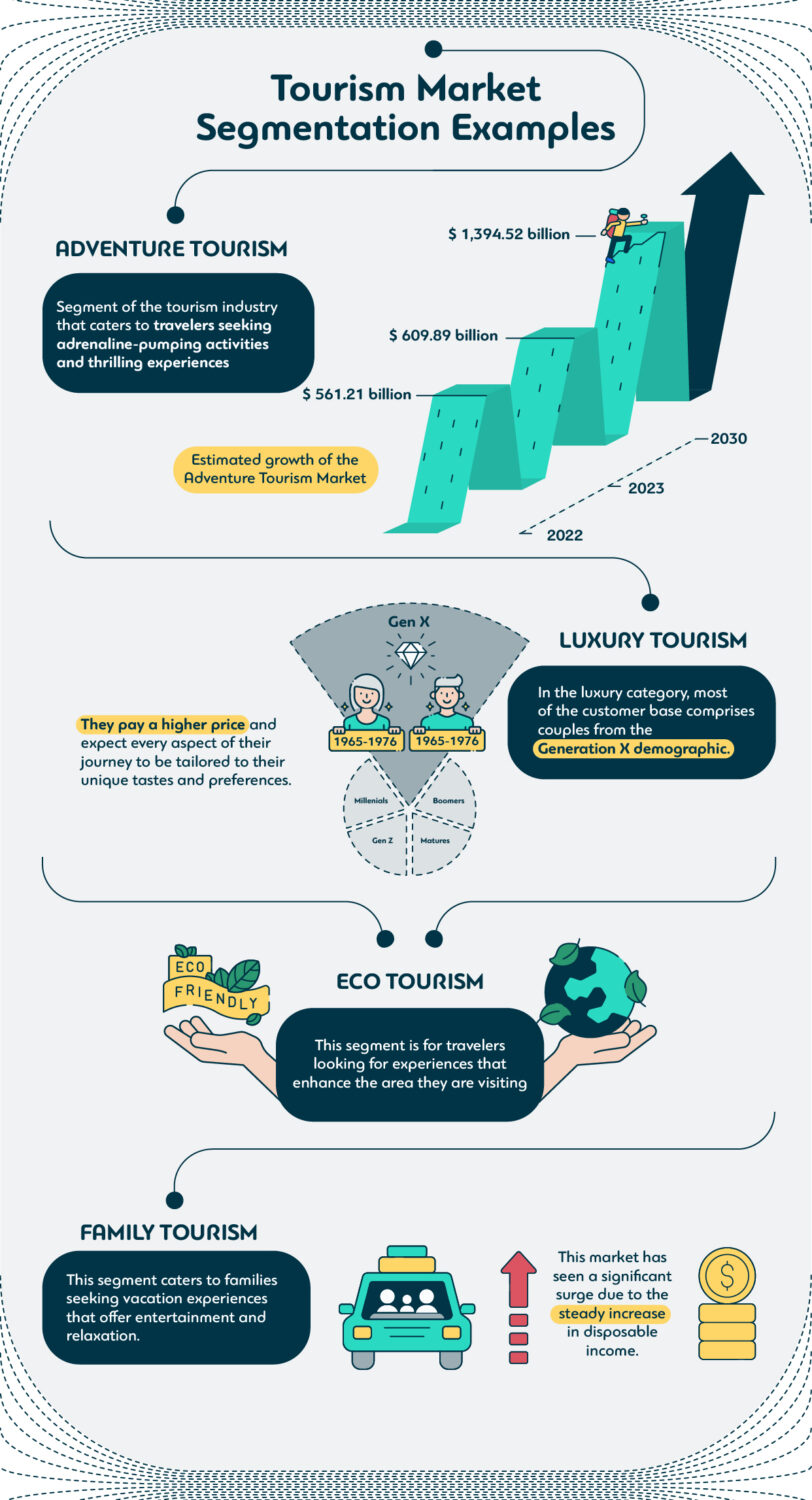
Adventure tourism is a growing segment of the tourism industry. This segment caters to travelers seeking adrenaline-pumping activities and thrilling experiences, such as skydiving, scuba diving, and mountain climbing.
Adventure tourism is usually associated with outdoor activities and adventure sports but also includes cultural activities such as trekking through remote villages. This often leads travelers to accommodations in tents or budget-friendly places.
The estimated size of the Adventure Tourism Market globally was around $USD 561.21 billion in 2022 and $USD 609.89 billion in 2023. If current trends continue, experts predict it will reach a whopping $1,394.52 billion by 2030.
Through market segmentation, businesses can identify adventure-seeking customers they currently serve or want to serve and create travel products and packages around their interests.
Traveling allows people to leave their comfort zones and experience the thrill of the unknown. From discovering ancient ruins in the depths of the Amazon rainforest to swimming with sharks in South Africa, adventure tourism offers unforgettable experiences.
Case Study 2: Luxury Tourism
Luxury tourism is a high-end segment that caters to travelers seeking luxurious accommodations, services, and experiences.
Accommodation options in this segment are often high-end hotels, resorts, or private villas. They are known for their lavish amenities, stunning decor, and exceptional services.
In the luxury category, most of the customer base comprises couples from the Generation X demographic. The customers in this category have elevated standards compared to others. Given that they pay a higher price, they expect every aspect of their journey to be tailored to their unique tastes and preferences.
Case Study 3: Ecotourism
Ecotourism is a niche segment that caters to environmentally-conscious travelers seeking sustainable travel experiences.
Tourism of this kind is centered around awareness and preservation. Ecotourism involves responsible travel that carefully conserves, manages, and protects the environment and the local population’s well-being.
Travelers are looking for experiences that enhance the area they are visiting by participating in activities involving planting trees or supporting the local community.
Online travel agencies have been leveraging ecotourism in their marketing strategies to attract travelers looking for sustainable experiences. For example, hotels and resorts use eco-friendly materials, energy conservation methods, and green products to be more sustainable.
Case Study 4: Family Tourism
Family tourism is a segment that caters to families seeking vacation experiences that offer entertainment and relaxation.
Family-friendly destinations offer various activities and attractions for different age groups and interests.
Many hotels offer spacious family suites or interconnected rooms that can easily accommodate larger groups. These accommodations often provide amenities like swimming pools, kids’ clubs, babysitting services, and entertainment.
The family tourism market has seen a significant surge due to the steady increase in disposable income. Nowadays, tourism is no longer considered a luxury but a must-have for families.
Conclusion
The travel industry is one of the most competitive industries in the world. Segmentation is a powerful tool that helps online travel agencies understand their target market’s unique needs and preferences, allowing them to better serve their segment-specific markets.
This is particularly crucial for online travel agencies, which must differentiate themselves from their competitors by offering personalized services that cater to their target audience’s unique interests and expectations.
Frequently Asked Questions (FAQ)
Online travel agencies can effectively use market segmentation data to identify customer needs, create targeted marketing campaigns, focus product development priorities, and inform pricing decisions.
Market segmentation data can be implemented to create more target marketing strategies as OTAs now know who they are talking to. They can efficiently allocate their resources to the tasks and activities they now will gain a greater ROI.
Additionally, they can use this data to improve their current and future product offerings.
Some common challenges in implementing market segmentation in the tourism industry include a lack of data and resources. Obtaining customer insights and data can be a lengthy process.
However, there are tools and resources that OTAs can use to gather the insights they need to make informed decisions, such as Google travel insights and customer interviews.
Another challenge is a lack of understanding of customer segments and needs. This is because consumer needs and preferences are constantly changing. OTAs need to stay on top of trends and changes to ensure their segment’s needs are still being met.
Online travel agencies can adapt their market segmentation strategies in response to changing customer preferences and market trends by regularly monitoring changes in customer needs, updating the data used for analysis, and testing new tactics.
OTAs can review their market segmentation strategies every six months to a year to ensure they are still consistent with current trends and expectations.
Yes, market segmentation can help online travel agencies manage crises. Many OTAs had no choice but to implement new strategies during the pandemic.
For example, as travel restrictions loosened and people could start traveling again, there was a lot of concern about getting stuck in a foreign country or being unable to get a refund if anything went wrong.
Specifically, behavioral segmentation helps understand consumers’ pain points and how you can cater to them. In the case of the pandemic, many businesses implemented flexible booking policies, such as free cancellation or no change fees.
Online travel agencies should consider targeting emerging market segments in the tourism industry. Travelers are increasingly seeking out unique and immersive experiences when they travel post-pandemic.
There has been a rise in the popularity of niche tourism, such as eco-tourism, wellness tourism, culinary tourism, and voluntourism. Additionally, millennials, Gen Z, solo travelers, family vacationers, digital nomads, and adventure seekers have recently gained more popularity.
These segments represent higher engagement and loyalty with travel brands, offering unique opportunities for differentiated experiences and services.
Market segmentation provides a foundation for successful audience targeting in tourism. It helps travel businesses better understand their audience, create personalized content and recommendations, and reach them with the right message in the right place and at the right time. As a result, segmentation can significantly impact customer engagement and loyalty, as well as the number of conversions.
The four main segments in the tourism industry help travel businesses differentiate types of travelers based on their geographic, demographic, psychographic, and behavioral characteristics.

Subscribe to
our newsletter
Yay! You are now
subscribed to our
newsletter
Mize is the leading hotel booking optimization solution in the world. With over 170 partners using our fintech products, Mize creates new extra profit for the hotel booking industry using its fully automated proprietary technology and has generated hundreds of millions of dollars in revenue across its suite of products for its partners. Mize was founded in 2016 with its headquarters in Tel Aviv and offices worldwide.
Related Posts

Business Travel Rewards Programs for Travel Agencies
19 min. Business travel rewards programs are powerful tools, but they often fail to deliver value because of poor agency handling. This guide is for agencies that want to master program selection and management and take up a more important role in corporate trip planning. Today, you will learn how to: Key Takeaways Point-based vs […]

How a New Wave of Travel Loyalty Programs Is Rewriting Traditional Rules
22 min. Loyalty programs are no longer just perks travelers get with bookings: the new generation of travel brands and loyalty professionals is turning them into full-scale travel and lifestyle platforms. Banks, fintechs, and other non-travel brands are among those writing the new rules. These new players are using travel rewards to build comprehensive ecosystems […]

AI in Tourism Marketing: Hyper-Personalization and more Bookings
25 min. It’s not that the tourism industry has a problem—after its victorious recovery from COVID-19, travel and hospitality will add $11 million to global GDP in 2024—but AI is set to fix and change how people travel for good. The emerging technology can spin the globe and find a perfect destination based on a […]
